
Daniela Draghici (65) reveals her three attempts at a backstreet abortion in 1970s Romania, where the Communist dictatorship banned the termination of pregnancy from 1966 until 1989
For more on Romania’s increasing restrictions on abortion access, see these features in The Black Sea and Libertatea written with Lina Vdovii
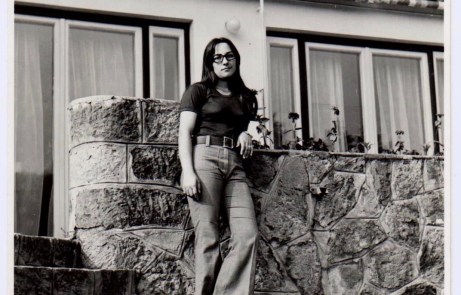
“People my age have not forgotten. But they prefer not to talk about it. They do not speak to their children, and I think that’s unfortunate because young people should know what their mothers, grandmothers or aunts went through. They would look at these women in a different way.
Sometimes Romanian women during Communism who had a backstreet abortion had complications afterwards, and had to go to an emergency hospital.
Here they were left on the hospital bed to bleed to death. They refused to tell the gynaecologist what they had done to themselves. If they did, those women would risk arrest and this could help curtail the underground abortion network.
Officially almost 10,000 women died from botched abortions in Romania between 1966 and 1989. But a lot of women died outside of any clinics or hospitals, and these numbers are unreported.
Underreporting is a national sport in Romania.
“They lined up the high school girls one by one”
In high school, the oppression by the state hit me. In the late 60s and early 70s, the Government’s attitude to girls in school was that we were supposed to just study and go to the university and not worry about anything else.
But I was listening to Radio Free Europe and the music on Voice of America, and going to the American Library in Bucharest. These three things helped me grow up normally, and to stay away from Communist indoctrination.
But I could not save myself from the medical check-ups. These were compulsory.
In 1966, the Communist Government banned abortion and, in 1967, the numbers of children born in Romania doubled, but in the following years the numbers went down again, so the Government wanted to know if women had undergone an abortion.
There was a medical room in every high school. Doctors in schools used to be very important. In Ion Luca Caragiale High School in Bucharest, where I studied, they lined up all the girls in a queue outside the room to face a check-up.
We were not told why this was going to happen, who was in there, nothing. We wondered – what are they going to look at? What are they going to tell us? What will they tell our parents, our teachers, the principal?
The school said we would have an X-ray for our lungs, and wanted to make sure that we were OK for the X-ray. Some say it’s not safe to have an X-ray when you’re pregnant. But that was a trick. They wanted to know if we were expecting.
I went into medical room where there was a male gynaecologist.
We could not get away from it. We could not get out of high school.
“Young people were afraid to have sex”
During communism, sexual education was a state secret and was allowed only in the medical school for doctors and would-be doctors. We had some hygiene classes, but there was not a lot of information. Our parents did not talk to us about this. There were bits and pieces that we picked up here and there, which were not necessarily correct. This misunderstanding and a lack of knowledge accounts for why a lot of young girls and women got pregnant.
Most of the information we had was through friends. I remember a friend who was a pharmacist, who was the only one who could provide us with barrier methods or pills. In the 1970s, if we didn’t know somebody who was a doctor, or someone in a pharmacy, we could not obtain contraceptive pills.
Otherwise, the only form of birth control we used was withdrawal.
Young people were afraid to have sex. They were afraid of pregnancy. They couldn’t even have pleasure. We never talked about pleasure. It was difficult because every single month we were thinking about getting our period. If we got our period we were very happy. If we didn’t, we were very worried, and started looking for ways out.
In 1976, I was 23 years old. I studied English and French, and was becoming a simultaneous interpreter. I was focused on my studies, while in my spare time I read photocopies of forbidden books, such as Animal Farm and 1984.
I had a boyfriend, but was not living with him. I was staying at different places, and could only move in with my boyfriend if we married.
I didn’t get my period so I was scared and waited, and my boyfriend was just as worried. The ways out were the pharmacist or someone who had a connection.
The first method was a lot of injections that were meant to induce the abortion. My boyfriend’s parents knew someone who knew someone else. His mother arranged the shots. I don’t remember if it was her who gave me the injections.
It only hurt. It didn’t work.
I waited. I heard stories about women trying to jump from a high place to shake their body, inserting all kinds of plants, pushing this instrument into the vagina to try and cause the elimination of the foetus. That didn’t work most of the time – and it didn’t work in my case.
My boyfriend’s parents took me to an elderly woman in an old country house somewhere outside Bucharest, where there was an ancient stove, where metal instruments were boiling in a pan.
On the kitchen table, she used these instruments on me.
There was no anaesthesia.
She put a rag in my mouth because there were neighbours around. With a curette, she started scraping the inside of the uterus.
A traditional curette is metal and sharp, similar to a thin spoon with a hole in the middle. It is like a torture instrument. All that sharp metal is supposed to scrape the uterus to free the pregnancy, and break it up into small pieces.
I don’t know if she was a trained doctor, maybe she was a midwife, or some woman in the village who knew how to perform it and managed to get a medical kit. We couldn’t go to the pharmacy and buy a kit. We had to have a connection in a hospital.
She was scraping like crazy on the kitchen table and it hurt horribly, and then she allowed me to breathe a little more, then she started again, and it went on forever.
For so many years, women were given abortions with this horrible, ancient instrument. I shudder when I think about it.
She kept saying to me that I should “Keep quiet!”. Her worry was that someone might hear me “It’s gonna be over,” she said.
I can almost see it like a dark place, with the light focusing on that part of my body.
I went home and I thought I’m safe. I got rid of it.
I thought I’m never going to have sex again.
But I continued having morning sickness, which was weird. I was very worried, I couldn’t understand what was happening – how I could still be pregnant after an abortion?
“It was like in action movies, I had to leave the money in a certain place”
The network was not very wide. There were not many providers, because everybody was afraid. Every single person involved in the network was unsafe. It was about somebody who knew somebody who knew somebody else, in a whole circle of trusted friends, which ultimately led to a person who performed the procedure.
Someone else took me to a doctor in a different apartment in Bucharest which belonged to some woman. Everything was hush-hush – when to do, where to go, what to do, what not to do, and to come with this amount of money. It was like in the action movies, I had to leave the money in a certain place. The money was difficult to come by. It was higher than a monthly salary.
It was an apartment building with lots of other apartments and, if I screamed, it was obvious that something was going on. People were very keen on reporting on others to the authorities at that time. Communism instilled suspicion. There was a thirst for hurting.
I experienced the same method as in the old country house, but with some kind of local anaesthesia.
I could feel what was going on. We can always feel. I did not scream. Again a rag was in my mouth. I was almost gagged. Women and girls do not scream. They want to get rid of it.
There was not much talk during the process.
He finished the abortion on the kitchen table.
I went home and took some antibiotics, just to make sure I would not get an infection. A lot of women died after complications from unsafe abortion procedures.
I have no idea who the gynaecologist was. I was not supposed to know. Afterwards, I had no interest in meeting the hero who saved me.
Unsafe methods were going on everywhere. Women were doing it to themselves in rural areas by whatever method they could.
Everyone had an abortion kit. This included a pipe (sonda), a thin catheter introduced in the uterus, used with with a mixture of water and soap and other liquids as an abortifacient. It did not always work, and women mostly got an infection, and then complications. In Romanian, sonda is the same word for oil well.
There was a sick joke. Why is Romania the richest country on the world? Because every woman has her own sonda.
I have no regrets. I wasn’t ready to have children at that time. Later I got married and had two sons. I used to bring home material about sex education and leave it on tables in the apartment. ‘Here she comes again!’ my eldest son would say. But he took the materials to bars and he educated young women to use contraceptives.
I’m trying to take all my stories to the world to tell the younger girls that they should be very careful how they live their lives and realise what kind of ordeal their mothers went through, and for all young people to have access to sexual education. This is a very serious business.
In 1984, I opened a private kindergarten in this apartment. I managed to raise a lot of un-indoctrinated kids.
In the 80s, I had a video taped from Soviet television. It showed how a birth underwater takes place. I presented this to the four to seven year olds. They saw there was no stork involved in the whole story. They were happy to see something like a miracle, the truth, the scientific truth because if we talk to them about the truth, it’s fine.
They were mesmerised, and so happy that, when their parents and grandparents came to pick them up, they started screaming to them: ‘Stop telling me the stork brought me here, because Daniela showed me how I was born’.
There was shock and terror on the part of the grandparents, but relief on the part of the younger parents.
They were happy they didn’t have to tell kids where they came from. This should be going on in schools and kindergartens.
It saves parents from lying to their kids.
Interview by Michael Bird
_____________________________________________________
- For more on this subject, see The Abortion Battleground, a project financed by JournalismFund
- Also: Groups linked to Pro-Life cause, Catholic Church in EU allocate €2.1 to €3.1m annually to lobby EU written with Blaz Zgaga in Nacional
- And: The Abortion Exodus – more Poles and Croats going abroad in EUObserver, written with Blaz Zgaga and Lina Vdovii
 Michael Bird Writer & Journalist