
A short story published in the Green Issue of Here Comes Everyone, Photo by Karl Anderson
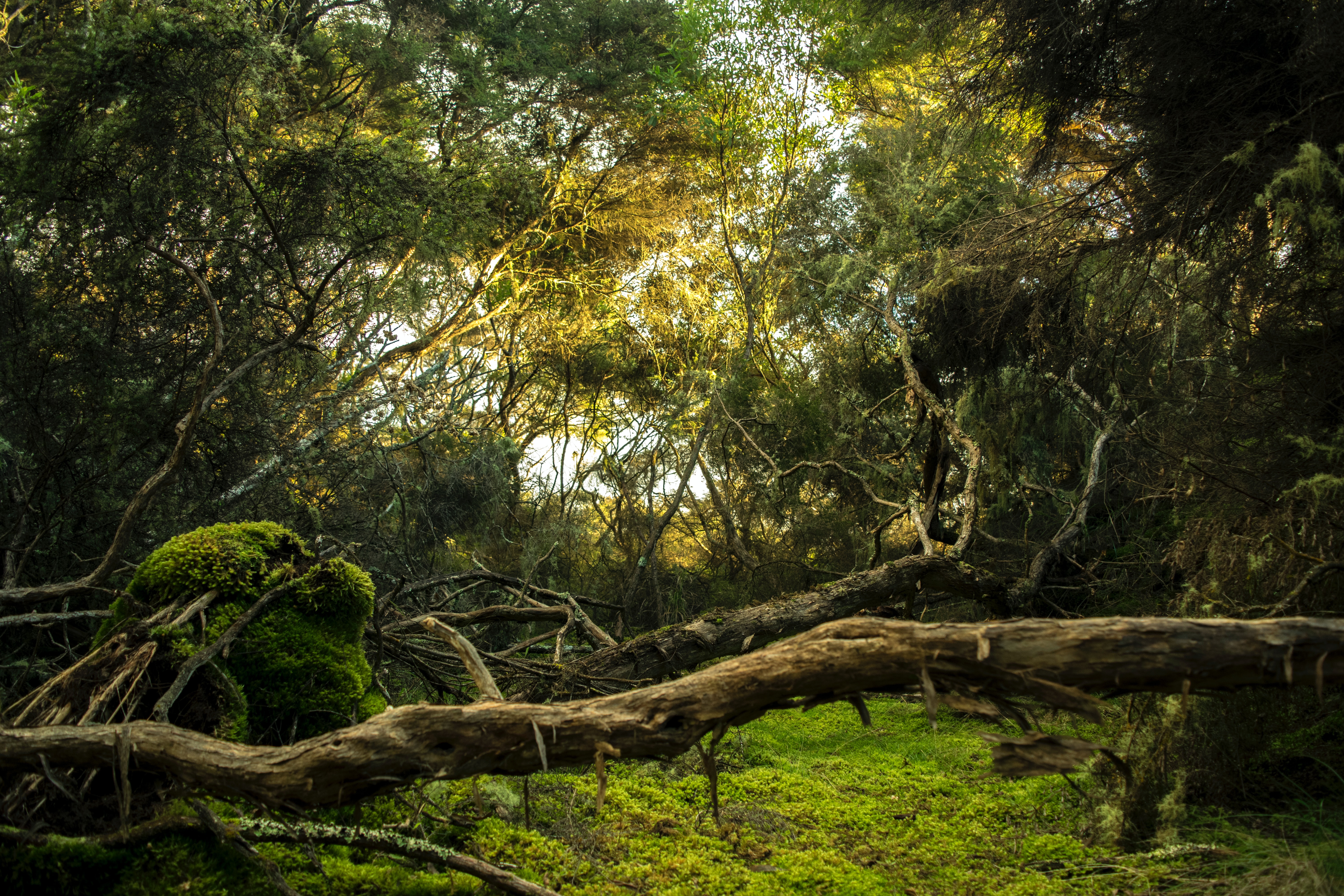
Wings, claws and pincers were everywhere. Flying, jumping, crawling, buzzing, spinning, nibbling, cutting, hustling, wrecking, rebuilding, eating, throwing up and eating the throw-up. In a wide-brimmed hat, poncho and loose pants, I kept watch on my feet, arms and legs, scared of something spiky or hairy wriggling over me, cleaving me, feeding on me. My skin reeked of bleach and burnt eggs from the bug spray, but there were so many of them, and they were so persistent, that to feel safe, I fogged my eyes, and zoned out, so they morphed into a black and green blur. As I could no longer see ahead, leaves and lianas smacked my face. I tilted up my face to focus on the dangers from above, but mud sucked in my boots, and I tripped over roots and thick vines. Bruised, bitten, stinking and blind, I realised the jungle was finding every possible way to tell me: fuck off.
My summer holiday was backpacking with eight other Americans in their twenties, and one guy from Sweden called Isak. My fellow nationals didn’t really engage with the rain forest, which was no more than a dare they had to complete or a backdrop for a photo-shoot. Now and again they said “wow” when they saw a big tree, lizard or spider, and took a picture with their phones, but their conversation stuck to college, jobs, ballgames and computer stuff.
Isak wasn’t like that. Slender, tall, almost white-skinned with albino-blonde hair, he seemed ageless and, to American eyes, a bit sick. When I asked how old he was (I guessed 30), he said 40 “or thereabouts”. When we talked about whether anyone had seen nature shows with monkeys, jaguars or crocodiles, he told me he didn’t watch TV. “I don’t think I ever owned one” was his response. That was crazy. Not the fact that he never had a TV, but that he couldn’t even remember. It was an optional extra to his life, like a pepper-grinder or an electric toothbrush. But he wasn’t aloof. He tried to mingle. When the boys were talking about baseball, he said: “Is that the one with the hoop?” They thought this was a lame joke, but I told them he was sincere. One guy asked him: “What did you major in?”. His answer was: “Oh, I was never in the Army.” To them, he was a freak.
I couldn’t stop sweating. Parts of me were moist in places where I didn’t even know I had glands. Plus the downpour was constant. Plants emptied water onto our heads and shoulders, from every angle, in trickles, gushes and floods. We tried to fight the wet, but soon got used to being soaked from daybreak to dusk.
By the second day, no one wanted to speak to Isak. When we all had to pick partners for a fishing trip to catch piranhas, only I volunteered to buddy with him. Together we sat on a raft, where he attached the hook to the line, and dangled it in the water, studiously waiting for a bite.
“Why did you come here?” I asked him.
“I wanted to be in a place that was opposite to everything I was familiar with and loved. And you?”
I thought about the town where I came from. The wide streets, full of cars. The large parks of big shops. The clothes in my wardrobe, which were no different from the clothes in my best friend’s wardrobe. The five thousand dollars my grandma left me in her will. The arguments with my parents.
“I’m not quite sure,” I said. “Not yet.”
At night we stayed in a massive room in a lodge, each of us in a hammock on hemp rugs, surrounded by mosquito nets. When we turned off the lamps, the trees shut down the sky. Nothing emitted light in even the smallest way. All we could sense was the rattle of cicadas and the damp air.
“I didn’t know it could be so dark,” I said.
“The jungle kills everything,” said Isak. “Why would colour be an exception?”
The rug nipped at my back. My neck ached.
“I can’t sleep,” I said.
Other voices came out of the shadows.
“Neither can I.”
“This is too intense.”
“I know what to do,” said Isak. “We can’t relax. We can’t see anything. So I should tell us a story. Then we can picture the story and it will help us sleep.”
“You gonna read us one, Isak?” laughed one of the boys.
“Like a Swedish folk tale or something?”
“That one about Heidi?”
#
Isak began.
It was the 19th Century. A tribe lived deep in the rainforest, close to a channel between two great rivers. No one from outside had ever visited their settlement.
Hundreds of miles away Europeans were stripping the trees away, and prospecting for minerals and rubber. The village elders sent scouts to observe the cities and industries that grew at the edge of the forest, and bring back knowledge they could use.
The tribesmen worked as labourers, pilots, farm-hands and stevedores, and spied on the rubber tappers, the iron mines, the garrisons and the missions. They watched how these intruders levelled the forest, paved the roads, built infrastructure, and erected towers of stone and iron. At first they were scared of the horse-drawn carriages, but soon became intrigued by the wheels, axles, chassis and levers, and even more fascinated by the steamships and trains.
The men helped build an opera house, but were not invited to the opening performance. While the orchestra tuned up, they sat outside in the dark, unsure what was about to happen. A woman’s voice began, louder than a night of cicadas. She wailed in lamentation, and would not stop. The men thought of childbirth. They thought of loss. They wondered about the purpose of this building, and agreed it was a place where kings and queens went to cry.
As they travelled back and forth between the towns, the ports and their village, the tribe traded their own timber and fruit for stone, lime, sand and tiles, and stole what they could.
In their own home by the river, they planned to make concrete, glass, cement and brick. They discussed how to construct large buildings, how they should look, and what materials they should mix together, in which proportions, and for how long they should burn sand for glass, and ore for iron.
Using palm trunks, they mapped out a town square. At its entrance, they raised an arch of stone with a thatched roof. In the centre, they planted a field of pineapple bushes. Here they built a tower of mud-bricks blended with sand and ash, and decorated its head in a clock face with shafts of bamboo as the hands and numbers. There was no mechanism inside, so time was fixed in a right angle, always reading 12:15.
In clay, they moulded a version of a conquistador riding a horse, and brandishing a spear. The steed carried the short and sturdy legs of a jaguar, the head of a crocodile, and the tail of a snake. The rider had the features and body of one of the elders.
Inspired by columns, arches and niches of the renaissance, they attempted to build a church, using bricks of mud, sand and lime. The result was a tall, open tower with a hexagonal spire holding a huge bell which contained no clapper or mallet. When the villagers wanted the bell to chime, three of its members climbed to the top of the tower, clung to the columns, and screamed to the jungle.
At the head of the square was an imitation of the opera house, which the people named the palace of hurt. This was made from a mix of mud-bricks and stone, with pillars of concrete, reinforced by a core of bamboo shafts. On its roof rose a dome, sculpted from mud and sand, and covered in broken ceramic, that reflected the sunlight at mid-day. Inside were timber seats and a stage, while a giant sculpture dangled from the ceiling, made from shards of glass and rings of iron. On wooden panels around the walls, a village artist painted scenes from the places where the tribespeople had worked, and of the cities they had seen, such as the church, the missionary, the train station and the foundries.
For several years, the village prospered, and while some members of the tribe left and came back, others stayed away to live in the new towns. The elders who championed the buildings lost their enthusiasm to continue. The walls of the church threatened to subside, and the stage and seating of the hall were lost to dampness. The roots and stems of the jungle entangled the buildings, while the mud claimed their foundations, which sank further into the earth.
A few years later an explorer, a linguist and a historian from Europe were navigating a boat up the river, when they spied the grey and white remains, half-buried in the forest. Immediately, they stopped at the jetty, and disembarked, stunned by such a unique vision in a wild location. In the shadow of the stone arch loitered naked men, women and children, with streaks of red pigment across their body and black paint in circles around their eyes. Inside what looked like a temple, stayed four families, mashing vegetables in wooden bowls. In the interior of what the visitors guessed to be a meeting house, mothers sat on the floor, breastfeeding their babies, while stitching together arrows.
They do not see the beauty that surrounds them! said the explorer.
What dazzled the newcomers most was the statue of the conquistador, now coiled in vines, blooming with white flowers, and hanging with red fruits.
What is this great construction that uses a primitive form of concrete? Asked the historian. A savage god? A vengeful angel? A hero? What is he riding? A crocodile? A big cat? A lizard? Some great animal that once flew or crawled here?
The linguist asked the villagers who had built these impressive forms. The elders were suspicious, as they had stolen much of the material from people who resembled these travellers. Between themselves, they discussed how to react, and decided to be vague. They said: it was our people, years ago.
The linguist assumed this meant the buildings dated back centuries, or even further, when a pre-Columbian society had once thrived in the forest.
There was tension. As the visitors examined the monuments and explored the buildings, they were concerned that these bare-skinned tree-dwellers would destroy such precious relics. The locals were annoyed by this intrusion, and remembered how many of their sons and daughters were taken by the Europeans.
No one knew how it happened. There may have been a disagreement over the use of the jetty, where the travellers wanted to dock more ships. Perhaps it was during an argument over whether the visitors could stay overnight in the village. It was not clear whether it was a member of the tribe who first fired an arrow, or one of the whites who shot a rifle at the villagers. But there was blood. Voices rang out from the tower to bring the tribe to the main square. The fighting escalated. The visitors had guns. Fearful for the safety of their children, the tribespeople fled into the forest.
Once the city was empty, the Europeans cleared the roots and shoots from the buildings, and planned to preserve, but also to extend, expand and build on what they found. What impressed them most were the paintings on wood in the palace of hurt. These were naive and two-dimensional in their approach, but created with dedication, using an angular style in pastel colours.
Look, said the explorer, how the ancients understood art and representation. They reproduced not only their own city, but a fantastic civilisation, and it has lasted, here on these panels, for so long.
We must learn their secrets.
#
“Isak, can we see it?”
“Who can take us there?”
“How much will it cost?”
The questions shot out from the darkness.
“There is a problem,” said Isak. “No one is sure where the city was, or remains.”
A chorus of ‘Wow’ sounded from all sides.
“It’s lost in the jungle?” I asked.
“I don’t think so,” he said. “It’s more complicated than that. You see, it could be any city in Brazil, or even on this continent, and I’m not sure which one. It’s possible that it might not be in South America at all, but could be in Africa, Asia or even Europe. It could be anywhere, and any city, or all of them.”
 Michael Bird Writer & Journalist